
In the world of kitchen appliances, the garbage disposal is perhaps the most misunderstood. Many homeowners and tenants treat it like a motorized trash can; a “workhorse” capable of devouring anything thrown its way.
At Action Plumbing, we like to correct that misconception early. A garbage disposal isn’t a heavy-duty grinder; it’s a sensitive piece of machinery designed for one very specific task: rinsing away the tiny organic particles left on a plate after it’s been scraped into the trash. When we treat it like a catch-all, we invite clogs, leaks, and motor burnouts.
Whether you are a homeowner looking to avoid a Saturday morning plumbing bill or a property manager trying to reduce maintenance overhead, understanding the limits of this appliance is the first step toward a functional kitchen.
The Anatomy of a Failure: Why They Stop Working
To understand why they fail, you first have to understand how they work. Unlike a blender, a disposal doesn’t have sharp, rotating blades. It uses two blunt metal “lugs” on a spinning plate to flick food against a stationary grind ring. If that process is interrupted by the wrong material, the unit fails.
1. The Accumulation of “Soft” Debris
Surprisingly, it isn’t always the hard stuff that kills a disposal. We often see units fail because of FOG (Fats, Oils, and Grease). When liquid grease is poured down the drain, it eventually cools and solidifies inside the disposal’s grind chamber and the P-trap.
Over time, this creates a sludge that slows down the motor and traps other food particles, leading to a “mechanical seizure.”
2. The Fiber Wrap
Property managers often deal with humming disposals in the fall and spring.
Why? Because that’s when people are processing fibrous vegetables like celery stalks, corn husks, and asparagus.
These long, stringy fibers don’t get ground up; instead, they wrap around the base of the impellers like a bird’s nest. This creates massive friction, eventually overheating the motor and tripping the internal breaker.
3. Foreign Objects
We’ve pulled everything from wedding rings to bottle caps out of disposal units. While metal objects are obvious culprits, micro-impacts from things like unpopped popcorn kernels or fruit pits can gradually dull the grind ring. Once that ring is dull, the food isn’t pulverized—it’s just spun around, leading to constant clogs.
To Repair or Replace? The Decision Matrix
When a disposal stops working, the immediate question is: Is it worth fixing? For a $150–$300 appliance, the cost of labor often outweighs the cost of a new unit. Use this guide to help make the call.
| Symptom | Primary Cause | Repair or Replace? |
| Humming sound, no movement | Internal jam or “stuck” impeller | Repair: Use a jam wrench to clear it and hit the reset button. |
| Water dripping from the bottom | Failed internal motor seal | Replace: Internal leaks cannot be safely repaired. |
| Total silence (No hum/No light) | Electrical short or burnt-out motor | Replace: If the reset button doesn’t work, the motor is dead. |
| Foul odor that won’t go away | Bio-film buildup in the plastic housing | Repair: Professional cleaning or DIY scouring. |
| Slow draining/Frequent clogs | Dull grind ring or undersized unit | Replace: Upgrade to a unit with higher torque/HP. |
When Garbage Disposal Replacement is the Smarter Financial Choice
For property managers especially, nursing an old disposal back to life is often a losing game. Here is when we recommend moving on to a new unit:
The Internal Leak Rule
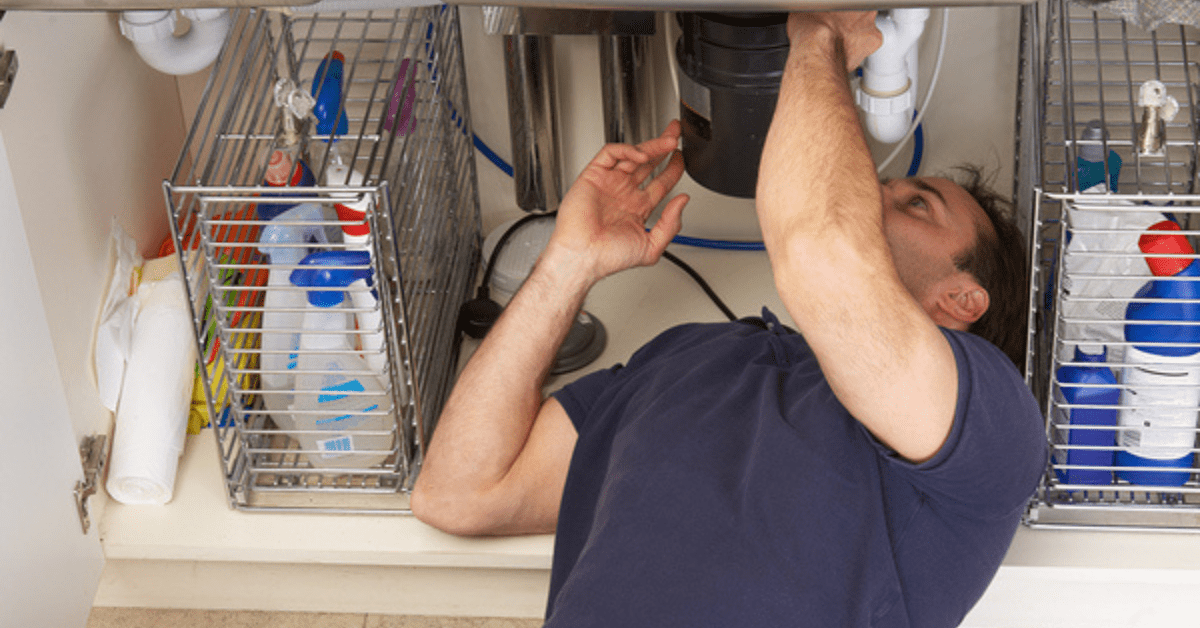
If you open the cabinet under the sink and see water dripping from the bottom of the disposal housing itself (not the pipes connected to it), the unit is done. This means the internal seal has perished, allowing water to leak into the motor housing. It’s an electrical hazard and a recipe for mold in your cabinetry.
The Age Factor (The 8-Year Mark)
Most mid-range disposals are designed to last about 8 to 12 years. If your unit is approaching a decade of service and starts requiring frequent resets or manual jams, the motor is likely losing its starting torque. Investing in a repair for an 8-year-old unit is usually throwing good money after bad.
Underpowered Units in High-Traffic Kitchens
Many builders install 1/3 Horsepower (HP) units because they are inexpensive. However, for a family of four or a rental property, these units are simply too weak. They jam easily and lack the “punch” to clear debris. Replacing a weak 1/3 HP unit with a 3/4 HP professional-grade model can drastically reduce the number of plumbing calls over the next five years.
Proactive Care: How to Prevent the Next Failure
If you want to keep your disposal out of the landfill, you have to treat it with a water-first mentality.
- The Scrape and Rinse Method: The disposal is for the residue that remains, not the leftovers from the plate.
- The Cold-Water Flush: Always use cold water when running the disposal. Hot water melts grease, allowing it to travel further into your pipes before it solidifies into a clog. Cold water keeps it solid so the disposal can break it into pieces.
- The Post-Run Flush: Don’t turn the water off the second the grinding sound stops. Let the water run for an additional 20 seconds to ensure the debris has cleared the trap under the sink and made its way to the main stack.
How Action Plumbing Supports You
At Action Plumbing, we don’t just swap out parts; we look at the whole system. We check the mounting assembly for vibrations that could loosen your sink flange, and we ensure the discharge tube is angled correctly to prevent standing water in the unit.
For property managers, we offer streamlined replacement services. If you have a building where the disposals are hitting that 10-year mark, we can coordinate a proactive replacement plan to help avoid any unforeseen failures.
